AI chat, agents, and bots. What's the difference?
The same chat window can explain a task or help carry it out. The difference is what happens after you ask.
Most people know how to chat with AI. But now we keep hearing about AI agents. And then there are bots. What's the difference?
The easiest way to explain it is with a hypothetical business task. Imagine you want to find out which customers have not paid their invoices.
Asking for advice or delegating the work
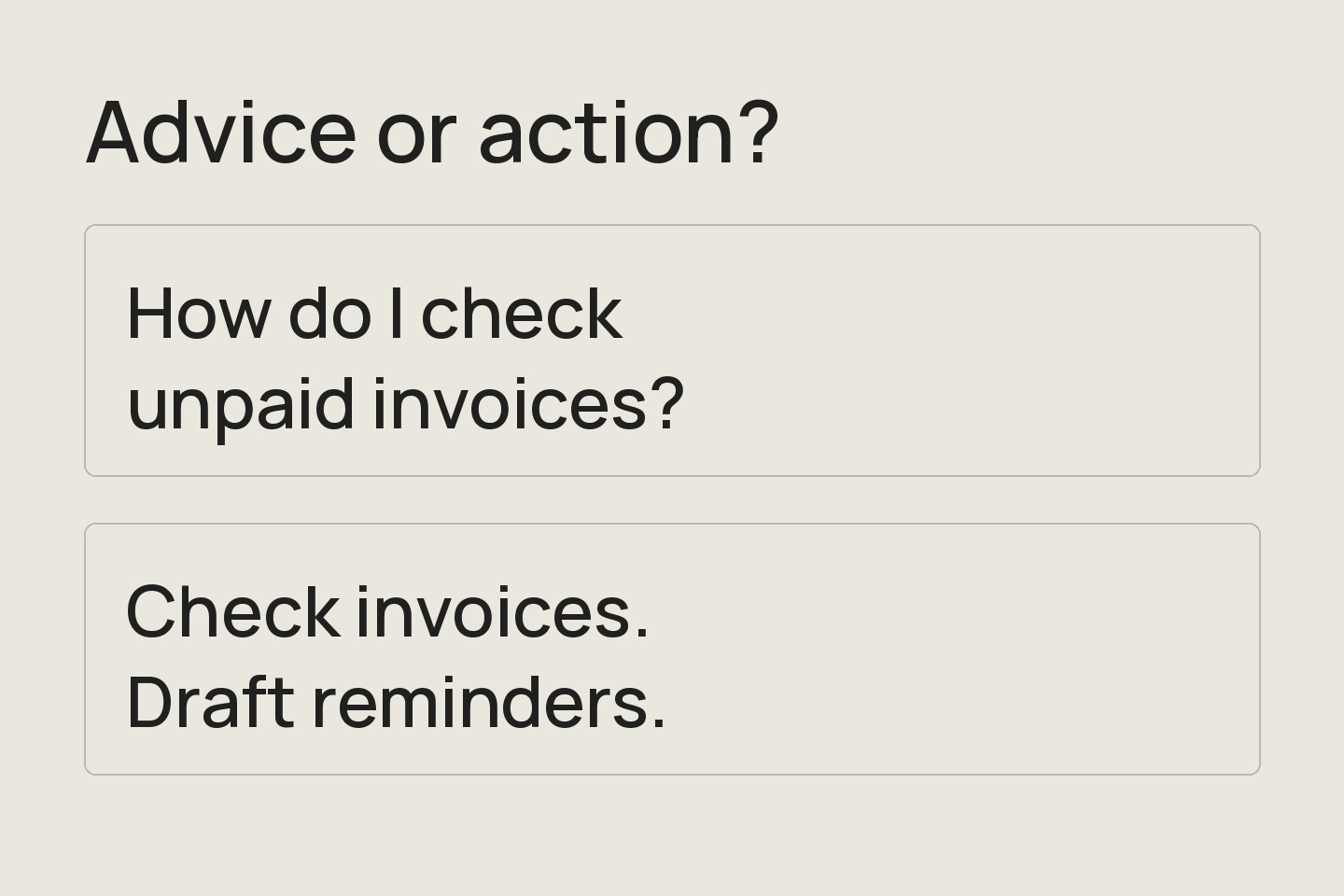
You ask: ‘How do I find out which customers haven't paid their invoices?’
An AI assistant explains what to check, suggests a spreadsheet layout and helps you write a payment reminder. You get a useful answer. Then you open your accounting software, check the payments and find the customer details yourself.
Now consider a different request: ‘Check my unpaid invoices, match them against incoming payments, and draft reminders for overdue customers.’
An agent with the right tools and access can work through those steps: retrieve the records, compare invoices with payments, identify overdue balances and prepare the emails. If sending requires your approval, it shows you the drafts and waits.
In the first case, you are asking how to do the work. In the second, you are delegating the work. These can be two modes inside the same product, not two different apps. A chat assistant with tools may also be able to carry out the second request.

What makes it an agent?
An AI agent receives a goal and can take multiple steps toward it: choose a tool, perform an action, inspect the result and decide what to do next. A tool is simply a way to do something outside the conversation, such as read an invoice or create an email draft.
For example, it might discover a payment with no invoice number and check the amount and sender. If there is no clear match, it should flag the uncertainty for you rather than mark an invoice as paid based on a guess.
An agent does not have to run around the clock. It can complete one assignment and stop. Or it can run on a schedule or respond to an event, if configured to do so.
I have described a real example in the story about shipping my car. The conversation happened in chat, but the work included contacting transport companies and coordinating a delivery. The chat was where I gave instructions, not where the task ended.
So what's a bot?
Bot is a broader term for an automated program. A bot might show buttons, provide order updates or send notifications, all without using AI.
A bot can also give you access to an AI agent. A Telegram bot, for example, could contain a fixed script, an AI that answers questions or a system that carries out tasks. The chat window alone does not tell you which one you are using.
That is the key distinction: chat is an interface. An agent is a system that can act toward a goal. You can interact with an agent through the same chat window you use to ask ordinary questions.
Access is not permission
Autonomy has boundaries. Access to your inbox does not automatically mean permission to send emails. Access to accounting records does not mean permission to move money. Those permissions need to be defined separately.
So when someone offers you an AI agent, ask what it can actually accomplish on its own, which tools it can use and when it needs a human. That answer tells you far more than the word agent on the website.
How it works for the technical reader
In the invoice example, the language model helps decide the next step. The surrounding software provides the tools, keeps track of the task and enforces access limits. The result of a tool call becomes information for the next decision.
A practical setup would separate reading invoices, reading payment records, creating drafts and sending messages into distinct permissions. Unclear payment matches go to a person. Sending stays blocked until the required approval is recorded. The ability to propose an action should not itself grant permission to execute it.